


睡眠ポリグラフ検査(PSG)のAI自動解析に関する研究論文が、米国睡眠学会(Sleep Research Society)発行の学術誌『SLEEP Advances』に掲載
― 睡眠段階・覚醒・呼吸イベントの自動判定で専門技師に迫る精度を達成。高品質な教師データの『一貫性』が高精度の鍵であることを実証 ―
東京大学発のスリープテック/ニューロテックスタートアップの株式会社ACCELStars(本社:福岡県久留米市、代表取締役:宮原禎、以下「ACCELStars」)の研究チームは、終夜睡眠ポリグラフ検査(PSG)から睡眠段階の判定・覚醒反応検出・呼吸イベント検出を自動で行う機械学習モデルを開発し、その性能が熟練した検査技師に迫る水準に達したことを明らかにしました。本研究成果は、米国睡眠学会(Sleep Research Society)が発行する学術誌 SLEEP Advances に2026年5月12日付でオープンアクセス論文として掲載されました。
本研究の最大の特徴は、モデルの複雑さよりも教師データに含まれるアノテーションの一貫性・品質こそが、到達可能な精度を決める重要な要因であることを、人間の技師間一致度との直接比較によって実証した点にあります。
背景
睡眠時無呼吸症候群(SAS)や不眠などの睡眠障害は、循環器・代謝・神経認知のリスク上昇と関連する、きわめて有病率の高い疾患群です。これらの診断において、PSGは現在もゴールドスタンダードの検査法とされています。
しかし、PSGのスコアリングは、訓練を受けた技師による目視での確認に大きく依存しており、
- 労力・時間がかかり、専門的な熟練を要する
- 判読精度が技師の知覚・認知の限界に左右される
- AASMのガイドラインに従っても、技師間でばらつきが生じる
といった課題が、診断のスループットや研究の再現性を制約してきました。こうした背景から、自動解析への関心が高まっています。
一方で、公開されているPSGデータベースは判読基準や前処理が統一されておらず、また人間が付与したアノテーションそのものの信頼性にも不確実性があるため、報告された性能指標を研究間で単純に比較することは困難でした。
研究内容
研究チームは、健常者およびSASが疑われる被験者から取得した終夜PSG記録を用い、以下のアプローチで課題に取り組みました。
1. 構造化されたキャリブレーションによる高品質な教師データの構築
異なる施設に所属する4名の認定スコアラーが、まず判読基準をすり合わせるキャリブレーションセッションを実施。基準を統一したうえで各記録を独立に判読することで、一貫性が担保された高品質なアノテーションを整備しました。さらに一部の記録は全員が独立して判読し、技師間一致度を定量化することで、モデルの性能を人間同士の一致度と直接比較できるようにしました。
2. 学習コストの低い勾配ブースティング決定木(GBDT)モデル
比較的シンプルで学習コストの低い機械学習モデルであるGBDTを採用。標準的な生体信号睡眠段階の推定結果を覚醒検出の特徴量に、睡眠段階と覚醒の推定結果を呼吸イベント検出の特徴量に用いる階層構造により、睡眠中の生理現象の依存関係を反映させました。
主な結果
3つのタスクすべてで、従来研究と比べて高い性能を達成しました。
| タスク | 主な性能指標 |
|---|---|
| 睡眠段階の判定 | Accuracy 0.840/Cohen’s kappa 0.791/F1スコア 0.841 |
| 覚醒検出 | Recall 0.725/Precision 0.742/F1スコア 0.733 |
| 呼吸イベント検出 | Recall 0.829/Precision 0.807/F1スコア 0.818 |
人間の技師間一致度との比較では、
- 睡眠段階の判定と覚醒検出において、モデルは人間の技師と同等の性能を示しました。
- 呼吸イベント検出については、人間の技師間一致度をやや下回ったものの、従来研究と比べれば高い絶対性能を維持していました。
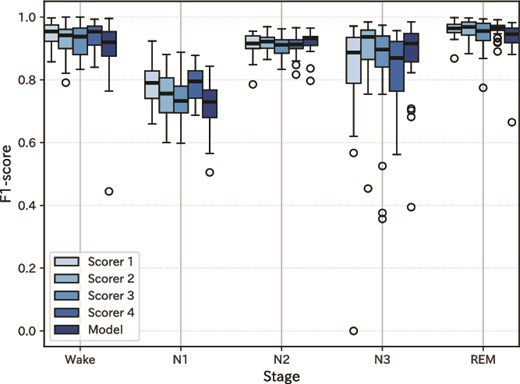
図. 人間の技師間一致度との比較
各睡眠段階(覚醒、N1、N2、N3、REM)について、27件の記録にわたるF1スコアの分布を、技師ごとおよびモデルの出力結果について箱ひげ図で示している。全ての睡眠段階においてModelの結果が人間の技師(Scorer)の精度と同等であることが分かる。
これらの結果は、睡眠段階や呼吸イベントなどの中核的な判読タスクにおいて、ディープラーニング系モデルのような学習コストが高い、複雑なモデルを用いなくても、GBDTのような比較的シンプルな機械学習アルゴリズムによって人間の判読に迫る性能を実現できることを示しています。特に本研究では、参照となるアノテーションの一貫性が高いデータを用いて検証しており、その高い人間一致度に近い水準までモデルが到達したことで、最終的に非常に高い判読精度が得られました。
本研究の意義
本研究は、自動解析の精度を高めるうえで、モデルの複雑さだけでなく、教師データの品質・一貫性が決定的に重要であることを、技師間一致度との直接比較という形で明確に示した点に大きな意義があります。
品質管理されたアノテーションに基づく自動解析システムは、
- 安定的で再現性のある参照出力を提供し、臨床判断を支援する
- 検査技師の教育・トレーニングに役立つ
- 施設間の判読基準の標準化に寄与する
といった可能性を持ちます。一方で、施設・集団をまたいだ検証、実環境での信号アーチファクトへの頑健性、臨床的に意味のある呼吸イベントのサブタイプへの拡張などが、今後の重要な課題として残されています。
論文情報
- タイトル: Automated sleep stage and event detection algorithms using quality-controlled polysomnography annotations
- 著者: Michiru Kaneda, Sho Ogaki, Tomoyuki Nohara, Syuhei Fujita, Naoshi Osako, Tomoko Yagi, Yasuhiro Tomita, Takanori Ogata
- 所属: 株式会社ACCELStars、久留米大学 医学部、虎の門病院 ほか
- 掲載誌: SLEEP Advances(Sleep Research Society / Oxford University Press), Volume 7, Issue 2, 2026, zpag054
- 公開日: 2026年5月12日
- DOI: https://doi.org/10.1093/sleepadvances/zpag054
- オープンアクセス(CC BY)
株式会社ACCELStars について
ACCELStarsは「睡眠を解明し、新たな医療を創造する」というビジョンのもと、東京大学 大学院医学系研究科教授の上田泰己が2020年8月に設立したメディカル・スリープテック企業です。
『SLEEP COMPASS』を中心とした睡眠ウェルネスサービスについては、産業保健領域における、従業員の睡眠習慣の改善に向けたニーズの高まり等を受けて、多くのお客様からご関心をいただいており、2023年5月のサービスローンチ以降、企業、保険者、自治体等を中心に、導入事業者数は98に達しました。
また、多くの医療機関・研究者との間で、睡眠障害関連疾患に加え、精神疾患、神経変性疾患領域における、共同研究を進めております。国内外の大学・医療機関・企業等との間で、170件の共同研究に関する協議を行い、61件、倫理審査承認の上、研究を実施しております。
そうした活動の中から、医薬品・医療機器・ヘルスケア機器・サービス開発に向けた支援要請の声をいただき、睡眠解析AIプラットフォーム・医療機器の提供にとどまらず、中枢神経のデジタルバイオマーカーの共同研究・開発や臨床研究や治験におけるエビデンス開発サービスも事業として展開を始めております。
【会社概要】
株式会社ACCELStars(アクセルスターズ)
代表取締役 宮原 禎
設立日:2020 年 8 月 28日
本社所在地:〒839-0864 福岡県久留米市百年公園1-1
東京オフィス:〒113-0033 東京都文京区本郷7-3-1東京大学アントレプレナープラザ205
HP:https://www.accelstars.com/
宮原 禎(代表取締役)
リクルートにて事業開発を経験後、複数社の経営経験を経てヘルスデータプラットフォーム株式会社代表取締役社長に就任。『PepUp』を立ち上げ、国内最大級のPHRサービスへ成長させる。JMDC統合後はFitbit社との日本独占提携などを指揮。2021年5月より現職。
上田 泰己(創業者 / 取締役)
2004年、東京大学大学院医学系研究科修了。03年から理化学研究所チームリーダー等を経て13年より東京大学大学院医学系研究科教授。現在、東京大学大学院情報理工学研究科教授等を兼務。専門はシステムズ薬理学・睡眠。
本件に関するお問い合わせ先
株式会社ACCELStars(アクセルスターズ)
広報担当:press@accelstars.com
Research Paper on AI-Based Automated Analysis of Polysomnography (PSG) Published in SLEEP Advances, a Journal of the Sleep Research Society (U.S.)
— Achieves accuracy approaching that of expert scoring technologists in the automated determination of sleep stages, arousals, and respiratory events. Demonstrates that the “consistency” of high-quality training data is key to high accuracy —
The research team at ACCELStars, Inc. (Headquarters: Kurume City, Fukuoka Prefecture; Representative Director: Tadashi Miyahara; hereinafter “ACCELStars”), a sleep-tech / neuro-tech startup originating from the University of Tokyo, has developed a machine learning model that automatically performs sleep stage classification, arousal detection, and respiratory event detection from overnight polysomnography (PSG), and has shown that its performance approaches the level of experienced scoring technologists. This research was published as an open-access paper on May 12, 2026, in SLEEP Advances, a journal published by the Sleep Research Society (U.S.).
The most notable feature of this study is that, through direct comparison with inter-scorer agreement among human technologists, it demonstrated that the consistency and quality of annotations in the training data—more than model complexity—is the critical factor determining achievable accuracy.
Background
Sleep disorders such as sleep apnea syndrome (SAS) and insomnia are highly prevalent conditions associated with elevated risk of cardiovascular, metabolic, and neurocognitive problems. PSG remains the gold-standard diagnostic test for these conditions.
However, PSG scoring depends heavily on visual review by trained technologists, which presents the following challenges:
- It is labor- and time-intensive and requires specialized expertise
- Scoring accuracy is constrained by the perceptual and cognitive limits of the technologist
- Even when AASM guidelines are followed, variability arises between technologists
These challenges have limited diagnostic throughput and research reproducibility, driving growing interest in automated analysis.
At the same time, publicly available PSG databases lack standardized scoring criteria and preprocessing, and there is inherent uncertainty in the reliability of the human-assigned annotations themselves, making it difficult to simply compare reported performance metrics across studies.
Study Details
Using overnight PSG recordings obtained from healthy subjects and subjects suspected of having SAS, the research team addressed these challenges with the following approach.
1. Building high-quality training data through structured calibration
Four certified scorers from different institutions first conducted a calibration session to align their scoring criteria. After standardizing the criteria, each recording was scored independently, producing consistently high-quality annotations. In addition, a subset of recordings was independently scored by all four scorers, allowing inter-scorer agreement to be quantified and the model’s performance to be compared directly against human inter-rater agreement.
2. A gradient boosting decision tree (GBDT) model with low training cost
The team adopted GBDT, a relatively simple machine learning model with low training cost. A hierarchical structure—in which sleep-stage estimates derived from standard biosignals are used as features for arousal detection, and the sleep-stage and arousal estimates are in turn used as features for respiratory event detection—was employed to reflect the dependency structure of physiological phenomena occurring during sleep.
Main Results
The model achieved higher performance than prior studies across all three tasks.
| Task | Key Performance Metrics |
| Sleep stage classification | Accuracy 0.840 / Cohen’s kappa 0.791 / F1 score 0.841 |
| Arousal detection | Recall 0.725 / Precision 0.742 / F1 score 0.733 |
| Respiratory event detection | Recall 0.829 / Precision 0.807 / F1 score 0.818 |
In comparison with human inter-scorer agreement:
- For sleep stage classification and arousal detection, the model performed on par with human technologists.
- For respiratory event detection, the model’s performance was slightly below human inter-scorer agreement, but still maintained high absolute performance compared with prior studies.
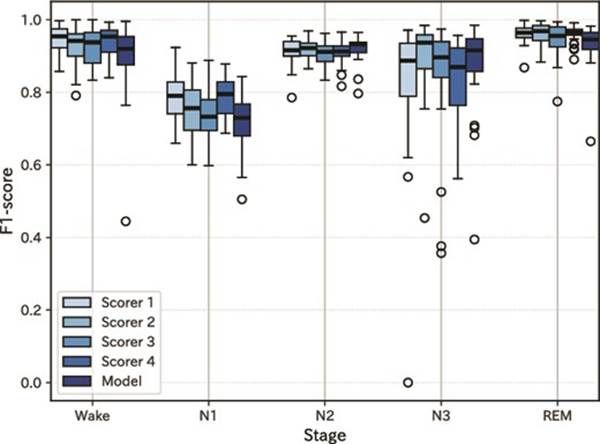
Fig. Comparison with human inter-scorer agreement
Box plots show the distribution of F1 scores across 27 recordings for each sleep stage (Wake, N1, N2, N3, REM), broken down by individual scorer and by the model’s output. Across all sleep stages, the model’s results are comparable in accuracy to the human scorers.
These results show that, for core scoring tasks such as sleep staging and respiratory events, a relatively simple machine learning algorithm such as GBDT can achieve performance approaching that of human scoring—without requiring complex, high-training-cost models such as deep learning. In particular, because this study was validated using data with highly consistent reference annotations, the model was able to reach a level close to that high degree of human agreement, ultimately achieving very high scoring accuracy.
Significance of This Study
This study is significant in that it clearly demonstrates, through direct comparison with inter-scorer agreement, that not only model complexity but also the quality and consistency of training-data annotations are critical to improving the accuracy of automated analysis.
Automated analysis systems based on quality-controlled annotations have the potential to:
- Provide stable, reproducible reference outputs that support clinical decision-making
- Support the education and training of scoring technologists
- Contribute to standardizing scoring criteria across institutions
At the same time, important challenges remain for future work, including validation across institutions and populations, robustness to signal artifacts in real-world settings, and extension to clinically meaningful subtypes of respiratory events.
Paper Information
- Title: Automated sleep stage and event detection algorithms using quality-controlled polysomnography annotations
- Authors: Michiru Kaneda, Sho Ogaki, Tomoyuki Nohara, Syuhei Fujita, Naoshi Osako, Tomoko Yagi, Yasuhiro Tomita, Takanori Ogata
- Affiliations: ACCELStars, Inc.; Kurume University School of Medicine; Toranomon Hospital; and others
- Journal: SLEEP Advances (Sleep Research Society / Oxford University Press), Volume 7, Issue 2, 2026, zpag054
- Publication date: May 12, 2026
- DOI: https://doi.org/10.1093/sleepadvances/zpag054
- Open Access (CC BY)
About ACCELStars, Inc.
Under the vision of “Elucidating sleep to create new forms of medicine,” ACCELStars is a medical sleep-tech company founded in August 2020 by Hiroki Ueda, Professor at the University of Tokyo Graduate School of Medicine.
Regarding its sleep-wellness services centered on “SLEEP COMPASS,” ACCELStars has received strong interest from many customers amid growing demand in occupational health for improving employees’ sleep habits. Since the service launch in May 2023, the number of adopting organizations—including companies, insurers, and municipalities—has reached 98.
The company is also conducting joint research with numerous medical institutions and researchers, spanning not only sleep-disorder-related conditions but also psychiatric and neurodegenerative disease areas. It has held discussions on 170 joint research projects with universities, medical institutions, and companies in Japan and abroad, and is conducting 61 of these under ethics committee approval.
Through these activities, ACCELStars has received requests for support in the development of pharmaceuticals, medical devices, and healthcare devices/services. Beyond providing its sleep-analysis AI platform and medical devices, the company has also begun offering joint research and development of central-nervous-system digital biomarkers, as well as evidence-development services for clinical research and trials.
[Company Overview]
ACCELStars, Inc.
Representative Director: Tadashi Miyahara
Founded: August 28, 2020
Head Office: 1-1 Hyakunen Koen, Kurume City, Fukuoka 839-0864, Japan
Tokyo Office: University of Tokyo Entrepreneur Plaza 205, 7-3-1 Hongo, Bunkyo-ku, Tokyo 113-0033, Japan
Website: https://www.accelstars.com/
Tadashi Miyahara (Representative Director)
After business-development experience at Recruit and management experience at several companies, he became President and Representative Director of Health Data Platform, Inc. He launched “PepUp” and grew it into one of Japan’s largest personal health record (PHR) services. Following the integration with JMDC, he led an exclusive partnership with Fitbit in Japan. He has held his current position since May 2021.
Hiroki Ueda (Founder / Director)
He completed his degree at the University of Tokyo Graduate School of Medicine in 2004. After serving as a team leader at RIKEN from 2003, he became a professor at the University of Tokyo Graduate School of Medicine in 2013. He currently also holds a professorship at the University of Tokyo Graduate School of Information Science and Technology. His specialties are systems pharmacology and sleep.
Media Contact
ACCELStars, Inc.
Public Relations: press@accelstars.com
 資料請求
資料請求 お問い合わせ